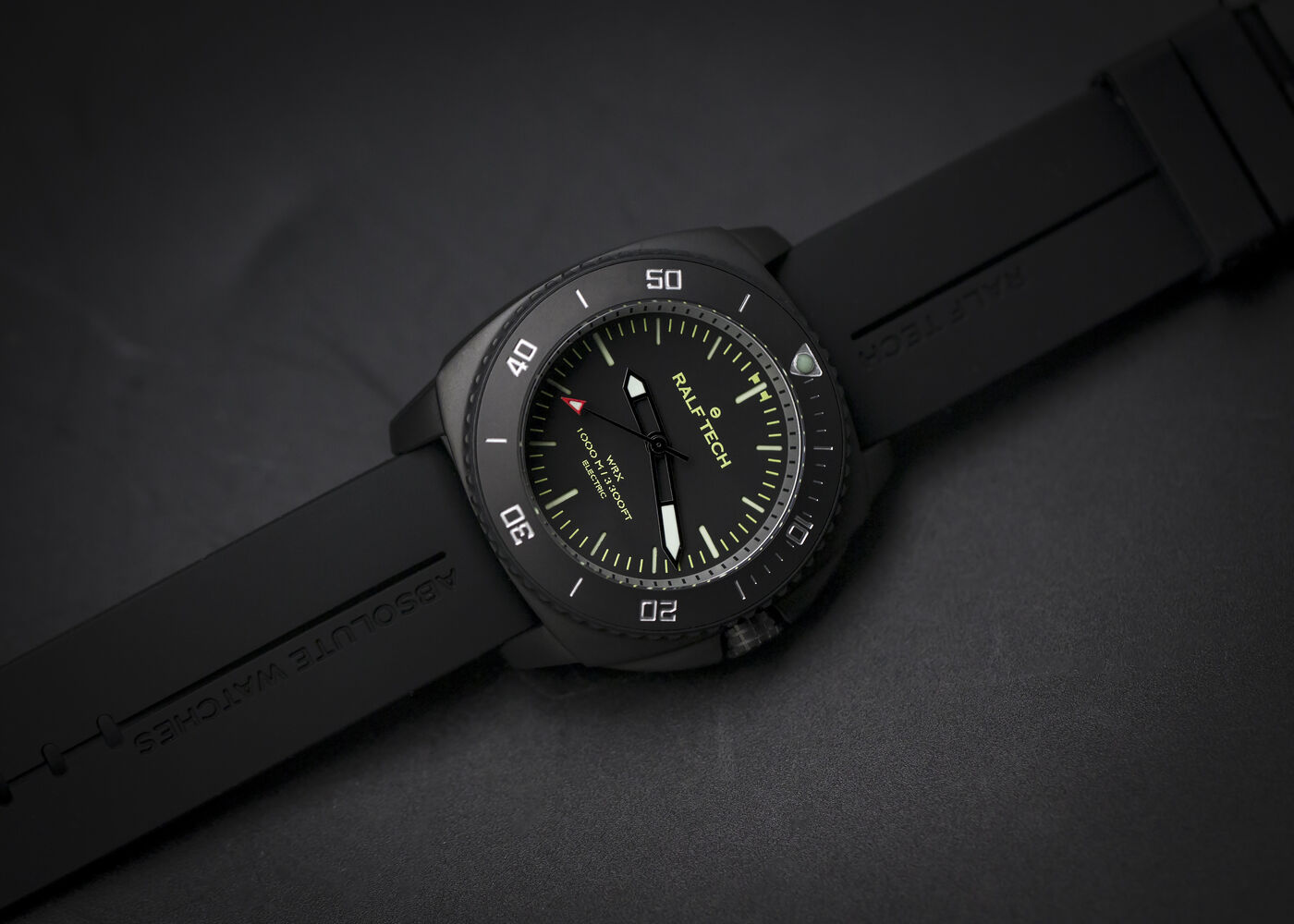
Let’s get something out of the way first.
The traditional wristwatch is an anachronism.
There, I said it.
We live surrounded by clocks. The time is displayed on our phones, computers, cars, televisions, ovens and countless other devices. Ask a voice assistant and it will tell you the time without requiring you to look at anything at all.

If the sole purpose of the wristwatch is to tell us what time it is, then its argument for continued existence appears fairly weak.
And yet we’re still wearing them.
We’re still designing them, manufacturing them, restoring them, collecting them, arguing about them and spending frankly unreasonable amounts of money on them.
Why?
Perhaps the interesting question isn’t whether the wristwatch has become anachronistic.
Perhaps it’s why we continue to find meaning in something we no longer strictly need.
And that is where the wristwatch becomes interesting.
Anachronistic Doesn’t Mean Meaningless
We often confuse technological redundancy with irrelevance.
They’re not the same thing.
The fountain pen survived the ballpoint. Vinyl survived digital music. Film photography survived the smartphone camera. Printed books survived the e-reader.
None remains dominant because it is objectively the most efficient solution to the problem it originally solved.
They survive because human beings don’t choose objects purely according to efficiency.

The wristwatch belongs to that same peculiar category.
It has evolved from a necessary instrument into something we actively choose.
And ironically, that may give it more meaning than it possessed when everybody simply needed one.
Choosing How We Experience Time
Checking a wristwatch is fundamentally different from checking a phone.
One exists almost exclusively to communicate time. The other happens to display the time while also providing access to your email, messages, news, social media, calendar and practically the entirety of recorded human knowledge.
One glance can very easily become ten minutes.
The traditional wristwatch asks almost nothing of you.
You raise your wrist. You look. You lower it again.
That’s it.
There is something increasingly appealing about an object designed to perform one small task extremely well.
Wearing one can therefore become an act of intentionality.
Not a rejection of technology. Certainly not in my case. Rather, it’s a decision that not every interaction in our lives needs to happen through the same glowing rectangle.

When Utility Becomes Something Else
For most of the wristwatch’s history, specifications mattered because they solved genuine problems.
Divers needed water resistance and elapsed-time bezels. Pilots needed legibility and useful calculations. Soldiers needed robust watches that could survive harsh environments. Scientists, explorers, sailors and engineers relied upon specialised instruments because the alternatives we take for granted today simply didn’t exist.
Today, most of us aren’t saturation divers, astronauts or fighter pilots.
And yet we remain fascinated by the objects created for those environments.
Why?
Because functionality can carry meaning even when the original necessity has disappeared.
A dive bezel may never see a decompression stop. A chronograph may spend its life timing pasta. A GMT complication might track another time zone simply because its owner enjoys seeing two places represented simultaneously.
The original utility hasn’t vanished.
It has become cultural memory.

A Tiny Piece of Engineering on Your Wrist
There’s also something wonderfully unnecessary about the engineering of a wristwatch.
Consider the absurdity of the mechanical watch.
We discovered much easier ways of measuring time decades ago, yet humans continue assembling springs, wheels, jewels, levers and escapements into tiny machines capable of running continuously on the wrist.
Quartz didn’t make that achievement less interesting.
Nor, for that matter, did quartz somehow remove the humanity from watchmaking.
Quartz watches have their own fascinating lineage of engineering: tuning forks, stepping motors, solar charging, thermocompensation, high-frequency movements and decades-long attempts to make timekeeping more accurate, robust and efficient.
Then there are the glorious oddities that resist convenient categorisation entirely: ana-digital instruments, LCD experiments, strange case constructions, unconventional displays and technological branches that briefly pointed toward an alternate future for the wristwatch.
These aren’t merely ways of knowing that it’s 3:47.
They’re evidence of how many different answers humans managed to invent for the extraordinarily simple question:
What time is it?
The Watch Becomes Personal
Once necessity disappears, choice takes over.
And choice is where things become personal.
One person chooses a restrained dress watch.
Another chooses an enormous tool watch that looks capable of surviving re-entry through the Earth’s atmosphere.
Someone else wears a battered watch inherited from their father.
Another person buys the exact digital watch they wanted when they were twelve.
None of these choices makes much sense if we’re evaluating watches purely as timekeeping appliances.
But people aren’t doing that.
The watch becomes autobiographical.
We remember where we bought watches. We associate them with birthdays, careers, relationships, travel, achievements and people. Certain scratches become irritating while others eventually become part of the object’s history.
Eventually a watch can stop being merely something we own.
It becomes something that was there.

Permanence in an Upgrade Culture
Perhaps this is also why the wristwatch feels particularly interesting today.
Much of modern technology exists within an upgrade cycle. Devices are replaced, platforms change and services evolve.
A traditional watch exists on a different timescale.
A mechanical watch may be serviced repeatedly across generations. A straightforward quartz watch can continue running for decades. Cases accumulate scratches. Bezels fade. Bracelets loosen. Dials age.
The object doesn’t necessarily become worse because it has become old.
Sometimes its age is precisely what makes it interesting.
That’s an increasingly unusual relationship to have with technology.
The Antithesis of Nihilism
So is the traditional wristwatch nihilistic?
I’d argue that it’s very nearly the opposite.
Nihilism questions inherent meaning.
The modern wristwatch demonstrates our extraordinary ability to create meaning where necessity no longer requires it.
We take an obsolete method of accomplishing an incredibly simple task and surround it with engineering, history, design, memory, identity and emotion.
The wristwatch doesn’t need to exist.
We choose for it to exist.
And perhaps that’s what makes it so compelling.

The Beautiful Anachronism
So yes, the wristwatch is anachronistic.
And that’s perfectly fine.
Its original monopoly on portable timekeeping has disappeared. What remains is arguably far more interesting.
The freedom to choose a watch because of its engineering.
Because of its history.
Because of its design.
Because someone important gave it to you.
Because it reminds you of something.
Or simply because looking down at that ridiculous chunk of steel strapped to your wrist makes you smile.
A watch no longer has to justify itself merely by telling us the time.
And in freeing it from that obligation, technological progress may inadvertently have given the wristwatch something even more valuable.
The freedom to mean whatever we want it to mean.